Henry VIII by Tracy Borman
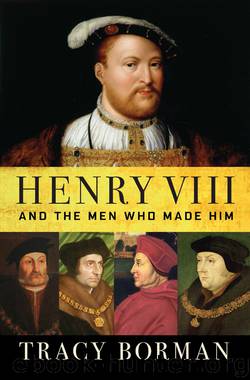
Author:Tracy Borman [Borman, Tracy]
Language: eng
Format: epub
ISBN: 9780802146403
Publisher: Grove Atlantic
Published: 2018-02-05T16:00:00+00:00
12
‘Every man here is for himself’
ANNE BOLEYN’S REMAINS, which had been hastily bundled into an old arrow chest, were barely cold by the time that her estranged husband was betrothed to Jane Seymour. They married ten days later, on 30 May 1536. Several of Henry’s men were in attendance, including Sir John Russell, who had weathered the storm of Anne Boleyn’s hostility towards him and was rewarded with increasing signs of favour from Henry now that she was dead. Although he had always been discreet, the strength of his disapproval of Anne and the influence that she had exerted over his beloved master was now clear. Writing to his friend Arthur Plantagenet, Viscount Lisle, shortly after the wedding, he rejoiced that the ‘king hath come out of hell into heaven for the gentleness of this [Jane] and the cursedness and unhappiness in the other [Anne]’.1
The new queen’s brothers – who were now brothers-in-law to the king – were quick to benefit from her exalted status. On 5 June, her eldest brother Edward was created Viscount Beauchamp, and before the summer was out he had also been appointed governor and captain of Jersey and Chancellor of north Wales. The greatest honour came on 22 May 1537, when he was admitted to the inner ring of the king’s council. Jane’s younger brother Thomas also enjoyed the bounties of his sister’s dazzling rise. By the beginning of October 1536 he was a gentleman of the privy chamber, and he seems to have impressed Henry because he was granted various other honours during the years that followed.
The Seymour brothers may have been the most immediate beneficiaries of Henry’s new marriage, but other men were quick to fill the posts left vacant by those who had been caught up in Anne’s fall. They included Thomas Heneage, who replaced Norris as groom of the stool, as well as chief gentleman of the privy chamber, following George Boleyn’s execution. A consummate courtier, he changed allegiance as deftly as he performed his duties to the king. He therefore now became a client of Thomas Cromwell, with whom he had served in Wolsey’s household. Well used to being an intermediary between a powerful patron and the king, he performed this task for Cromwell and soon became responsible for securing the king’s signature on important documents. Cromwell had the measure of Heneage, though, so he placed his trust in a number of other men too, notably Thomas Wriothesley and Ralph Sadler, both of whom were continuing to rise in the king’s favour.
In the scramble for places and honours that followed Anne Boleyn’s demise, Cromwell was undoubtedly the greatest winner. Even though cracks had begun to appear in the king’s relationship with his chief minister, in dispatching the unwanted queen with such devastating effectiveness, Cromwell had once more proved just how indispensable he was to his royal master. And now he was determined to capitalise upon his regained favour with Henry by planning a new suite of legislation that would accelerate the progress of his reforms.
Download
This site does not store any files on its server. We only index and link to content provided by other sites. Please contact the content providers to delete copyright contents if any and email us, we'll remove relevant links or contents immediately.
Fanny Burney by Claire Harman(26603)
Empire of the Sikhs by Patwant Singh(23086)
Out of India by Michael Foss(16853)
Leonardo da Vinci by Walter Isaacson(13336)
Small Great Things by Jodi Picoult(7142)
The Six Wives Of Henry VIII (WOMEN IN HISTORY) by Fraser Antonia(5515)
The Wind in My Hair by Masih Alinejad(5095)
A Higher Loyalty: Truth, Lies, and Leadership by James Comey(4964)
The Crown by Robert Lacey(4817)
The Lonely City by Olivia Laing(4802)
Millionaire: The Philanderer, Gambler, and Duelist Who Invented Modern Finance by Janet Gleeson(4478)
The Iron Duke by The Iron Duke(4356)
Papillon (English) by Henri Charrière(4274)
Sticky Fingers by Joe Hagan(4198)
Joan of Arc by Mary Gordon(4110)
Alive: The Story of the Andes Survivors by Piers Paul Read(4032)
Stalin by Stephen Kotkin(3965)
Aleister Crowley: The Biography by Tobias Churton(3640)
Ants Among Elephants by Sujatha Gidla(3467)
